
Wire-collated coil nails are widely used in pallet manufacturing, crate assembly, fencing, sheathing and other high-volume timber fastening jobs because they feed continuously through pneumatic coil nailers. For buyers, however, the key question is not simply “which coil nail is cheap?” It is whether the nail, coil and packaging match the nailer, material, finish requirement and daily production rhythm.
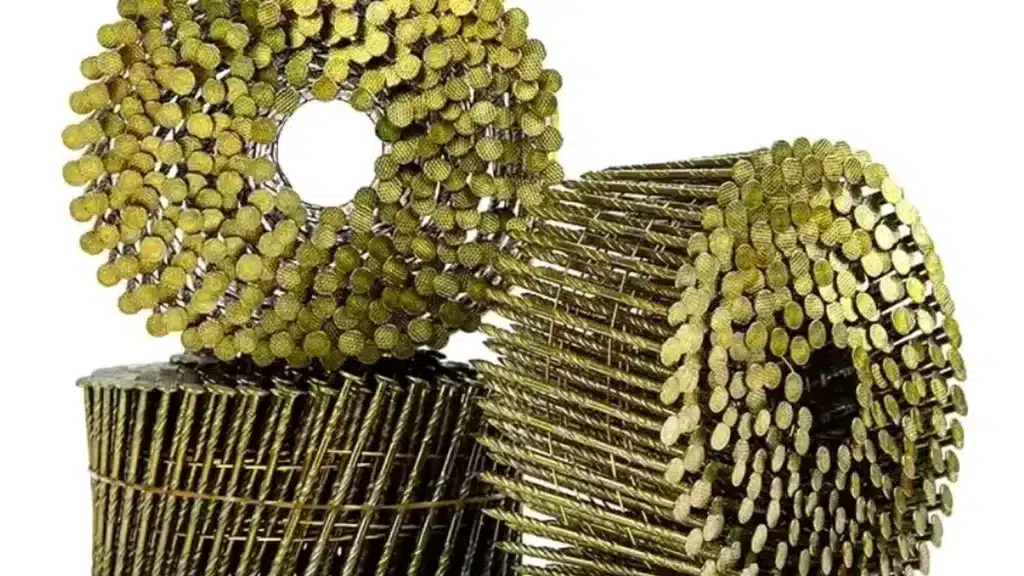
A coil nail that looks correct in a catalog can still cause feed stoppages if the collation wire, nail angle, coil diameter or head spacing does not suit the nailer. A nail that performs well in dry indoor crate work may not be the right choice for outdoor timber or pressure-treated wood. And for export orders, the carton, moisture protection and label details often matter as much as the nail specification itself.
This guide focuses on practical buying details for wire-collated coil nails so importers, distributors and pallet producers can request the right sample, compare quotations clearly and reduce avoidable trial problems.
What Wire-Collated Coil Nails Are
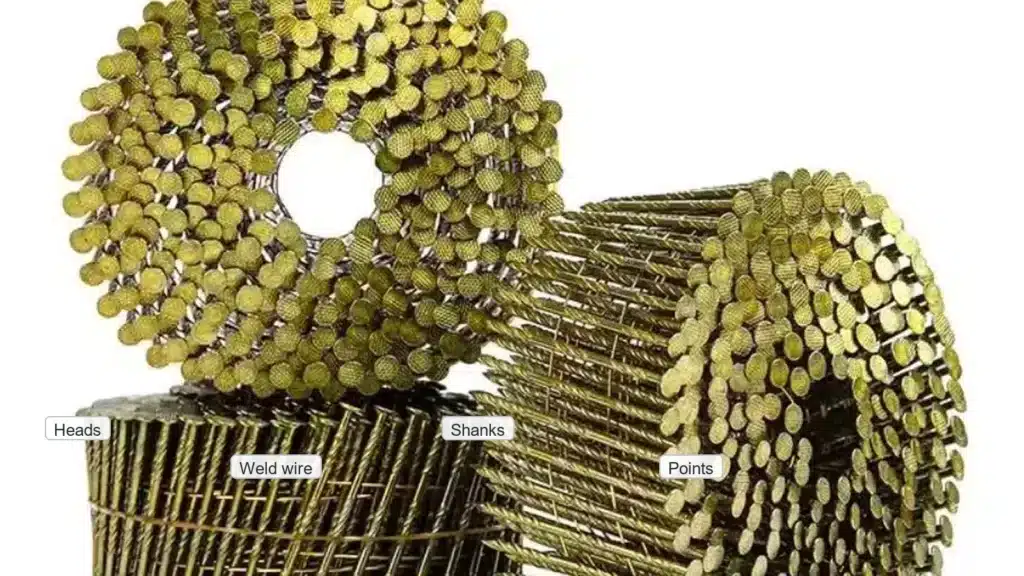
Wire-collated coil nails are individual nails connected by thin welding wires, then wound into a coil so they can be loaded into a coil nailer magazine. The collation keeps each nail in the correct sequence for fast feeding. In a production environment, this helps operators drive many nails without stopping to reload as often as they would with stick nails.
The basic nail still has familiar elements: head, shank, point, finish and length. The coil format adds several extra details that matter for compatibility:
- The angle of the collated nails
- The spacing and welding position of the wire
- The coil outside diameter and inner core shape
- The number of nails per coil
- The head diameter and head style
- The shank style, such as smooth, ring or screw shank
- The surface finish, such as bright, electro-galvanized or hot-dip galvanized
Because the nail is part of a feeding system, buyers should treat the coil as a complete fastener format rather than only a loose nail specification.
Why Nailer Compatibility Comes First
Most purchasing mistakes happen when the buyer specifies only nail length and wire diameter. Those details are important, but they do not prove that the coil will feed smoothly in the customer’s tool. Pneumatic coil nailers are built around a magazine size, feeding pawl, nose design and accepted collation angle. If the coil does not match those mechanical expectations, the result can be misfeeds, double feeds, bent nails or extra downtime.
Before confirming a bulk order, ask the end user or distributor for the nailer brand and model. If the brand is not available, request the existing nail sample and packaging label. A physical sample is especially useful when buyers are replacing a local brand or converting from one supplier to another.
The most important compatibility checks are:
| Compatibility Point | Why It Matters | What To Confirm |
|---|---|---|
| Collation angle | The feed path and magazine are designed for a certain nail angle | Match the current nail sample or nailer manual |
| Coil diameter | Oversized coils may not sit correctly in the magazine | Confirm outside diameter and nails per coil |
| Wire position | The welding wire must not interfere with the nose or feed pawl | Compare with the sample coil |
| Head diameter | Too large or too small can affect feeding and holding | Confirm accepted head range |
| Shank style | Ring and screw shanks drive differently from smooth shanks | Match the timber and holding requirement |
| Finish | Coating affects corrosion resistance and sometimes driving feel | Match exposure and customer specification |
For general driven fastener terminology and dimensions, buyers can also refer to ASTM F1667. The standard is not a substitute for the nailer manufacturer’s tool requirements, but it is useful when the order needs a common technical language.
Match the Nail to the Application
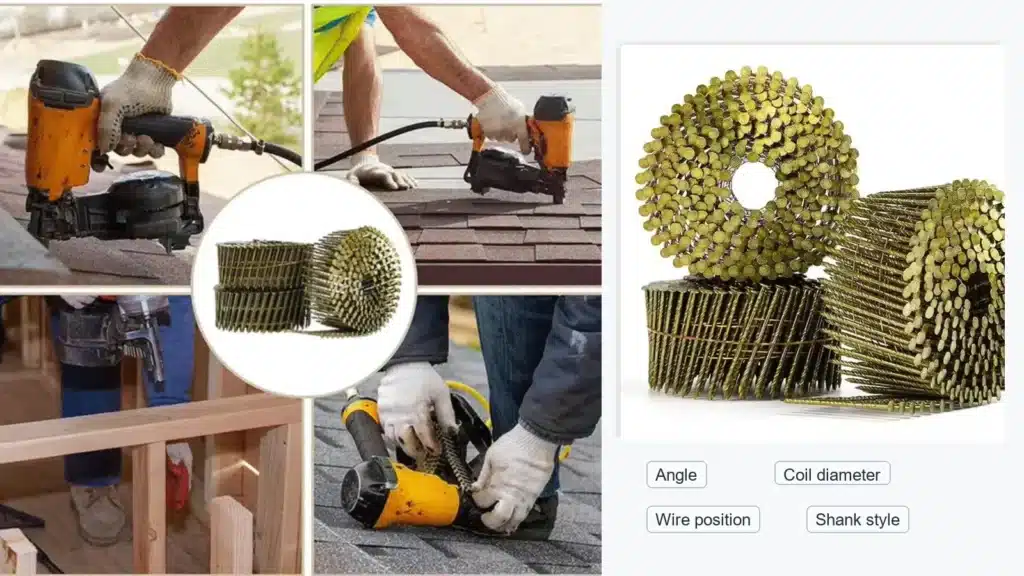
Pallet factories, crate builders and timber packaging shops often use coil nails in repetitive work, but their requirements are not identical. A light export crate, a heavy pallet block and an outdoor fencing panel can place different demands on the nail.
For pallet and crate assembly, buyers usually look at holding power, production speed and cost consistency. Ring shank or screw shank coil nails can improve withdrawal resistance compared with smooth shank nails, but they may require more driving force and should be tested in the actual timber. For buyers still comparing shank choices, the existing Fastener Nails guide on ring shank vs screw shank coil nails is a useful companion article.
For indoor packaging, bright or electro-galvanized coil nails may be suitable when corrosion exposure is limited. For outdoor timber, damp storage or treated wood, the finish needs closer review. The earlier guide on electro-galvanized vs hot-dip galvanized coil nails explains that coating choice should not be reduced to a simple good-or-bad comparison. Exposure, timber chemistry and customer requirements all matter.
For pressure-treated wood, corrosion conditions can be more demanding. Buyers should avoid guessing and should review the wood supplier’s recommendation and project requirements. Simpson Strong-Tie provides a useful industry reference on fasteners and corrosion in pressure-treated wood.
Order Details Buyers Should Put in the RFQ
A clear RFQ saves time for both buyer and manufacturer. Instead of sending only “coil nails 2.5 x 50 mm,” include the details that affect production and compatibility.
Useful order information includes:
- Nail length and wire diameter
- Head diameter and head style
- Shank style: smooth, ring, screw or other required form
- Point type if the project has a specific need
- Surface finish: bright, electro-galvanized, hot-dip galvanized or other confirmed finish
- Collation type: wire-collated
- Collation angle, if known
- Nails per coil and coils per carton
- Nailer model or existing nail sample
- Application: pallet, crate, fencing, sheathing or other timber work
- Packing requirements, including carton strength, palletizing and moisture protection
- Label requirements without unsupported certification claims
If the buyer is a distributor, it is wise to separate “must match” details from “can adjust” details. For example, the nailer model and coil format may be fixed, while carton printing or pallet configuration may be adjusted for the importer’s warehouse.
Sample Testing Before Bulk Orders
For a first order, sample testing should not be skipped. A good sample review checks feeding, driving, holding and packaging.
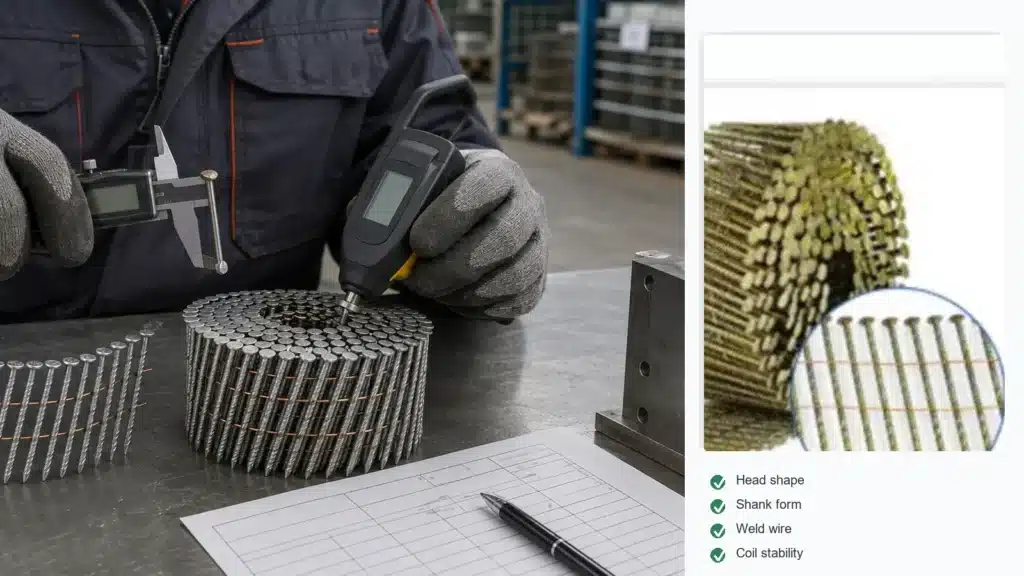
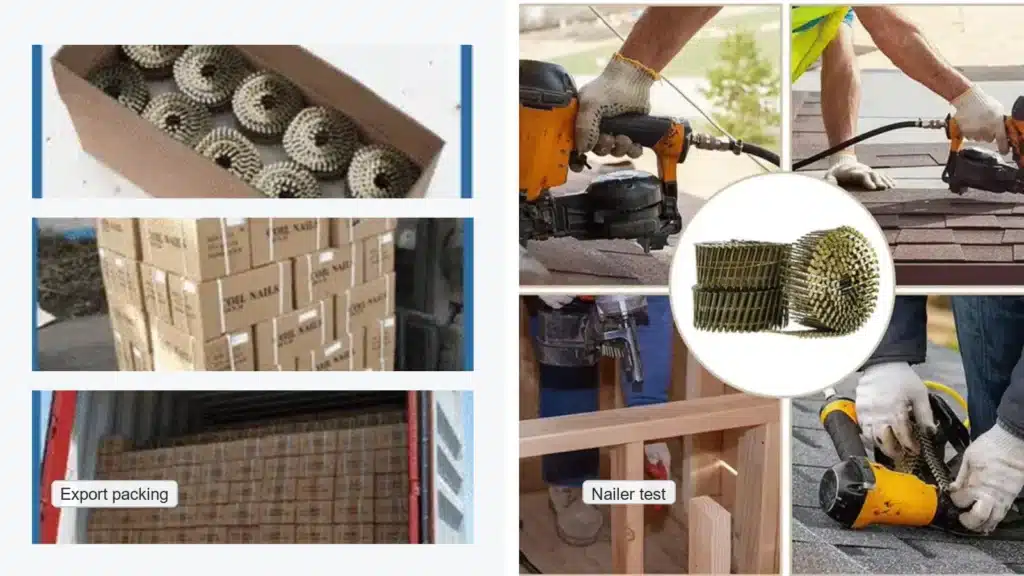
In the nailer test, load the coil normally and observe whether the nails feed cleanly through several repeated cycles. Watch for curled wire, broken collation, feed hesitation, bent nails and double feeding. Test in the real material if possible, because dense timber, knots, moisture level and board thickness can change the driving result.
In the product inspection, look at head shape, shank form, point consistency and weld wire alignment. The coil should stay stable during handling, but the collation should still separate properly when driven by the tool. Coils should not collapse in the carton during shipment.
Packing and Export Handling
Coil nails are heavy for their size. Poor packing can turn a correct product into a shipment problem. Cartons should hold the coils firmly enough to prevent crushing or distortion. Inner protection should reduce moisture contact and abrasion during transit. Pallets should be stable, and carton labels should be practical for warehouse handling.
Buyers should confirm:
- Coil quantity per carton
- Gross and net weight expectations
- Inner moisture protection
- Carton strength and pallet layout
- Shipping mark content
- Whether cartons need neutral packing or buyer branding
- Whether the final buyer needs barcode or item code labels
Do not ask the supplier to print certifications, test results or compliance marks unless they are real and supported by documents. Unsupported labels can create customs, customer and reputation problems.
Common Buying Mistakes
The first common mistake is treating all wire-collated coil nails as interchangeable. Two coils with similar nail length can behave differently if the angle, wire position or coil diameter changes.
The second mistake is choosing a finish only by price. For low exposure indoor use, a simple finish may be acceptable. For outdoor storage, treated wood or humid conditions, the finish should be selected more carefully and confirmed with the customer’s application.
The third mistake is approving bulk production without testing the nailer. A catalog photo cannot prove feed compatibility.
The fourth mistake is ignoring packaging. Coil nails can be damaged by weak cartons, poor stacking or moisture exposure. For importers, packaging is part of product quality.
A Practical Specification Checklist
Before placing an order, send the supplier a simple checklist:
- Application and timber type
- Nailer brand and model, or existing coil nail sample
- Nail length, diameter, head and point
- Shank style and finish
- Collation angle, wire position and nails per coil
- Quantity per carton and carton weight target
- Palletizing, shipping mark and warehouse requirements
- Sample test result and any adjustment needed
This approach helps the supplier quote the correct product and helps the buyer compare offers on the same basis.
Conclusão
Wire-collated coil nails should be purchased as a tool-compatible fastening system, not just as loose nails wound into a coil. The best order starts with the nailer model or existing sample, then confirms collation angle, coil size, shank, finish, application and packing.
If you are sourcing coil nails for pallet, crate or timber packaging production, Fastener Nails can help review your current sample, nailer requirement and packing details. Share your application, nailer model and target specification through the contact page so the quotation can be based on real compatibility requirements.
PERGUNTAS FREQUENTES
Are all wire-collated coil nails compatible with all coil nailers?
No. Coil nailers have specific requirements for angle, coil size, head size and collation format. Always confirm the tool model or test against an existing nail sample.
Do I need ring shank or screw shank coil nails?
It depends on the holding requirement, timber type and driving conditions. Ring and screw shanks can increase withdrawal resistance, but they should be tested in the real application and nailer.
Is hot-dip galvanized always better than electro-galvanized?
Not always. Hot-dip galvanized nails are often chosen for higher exposure, but the right finish depends on application, timber chemistry, storage and customer requirements. Avoid using salt spray hours as a direct service-life promise.
What should I send before asking for a quotation?
Send the nailer model, current nail sample if available, nail length, diameter, shank style, finish, application, nails per coil and packing requirement.
Should I test samples before a bulk order?
Yes. Sample testing is the safest way to confirm feeding, driving, holding and packing before full production.
 Portuguese
  English
  Arabic
  Spanish