
Buyers often ask us a simple question: “Should I use C17 or C24 hog rings?”
The answer depends on more than the size of the ring. The correct choice must match the pneumatic tool, the combined thickness of the materials and the required diameter after the ring is closed.
A ring that is too large may leave the connection loose. A ring that is too small may damage the material, fail to close correctly or place excessive stress on the tool. An incompatible ring can also cause unstable feeding and repeated jams.
This guide explains the practical differences between C17 and C24 hog rings and shows buyers how to select the correct ring, tool and material for their application.

What Is the Main Difference Between C17 and C24 Hog Rings?
C17 is the smaller hog ring series. It is commonly used with 16-gauge SC760-series pneumatic tools for automotive seats, furniture upholstery, light wire cages, packaging nets and other small-diameter fastening work.
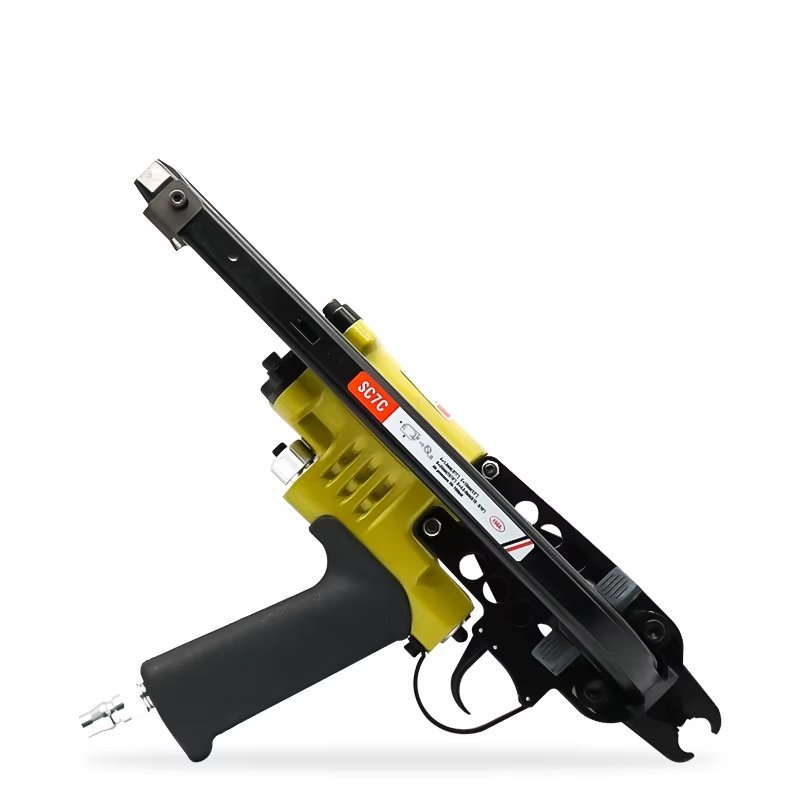
C24 is a larger and heavier series. It is normally used with 15-gauge SC7C or SC7E pneumatic tools for mattresses, fencing, wire cages, furniture and heavier industrial assembly.
The important point is that ring size does not determine the final closure by itself. The jaws of the pneumatic tool control the final closed-ring diameter.
For example, SC7C and SC7E tools can use the same general C24 ring family but produce different finished closures. Buyers therefore need to confirm both the fastener and the tool model.

C17 vs C24 Hog Rings at a Glance
| المواصفات | C17 Hog Rings | C24 Hog Rings |
|---|---|---|
| Common gauge | 16 gauge | 15 gauge |
| Typical wire diameter | Approximately 1.60mm | Approximately 1.80mm |
| Approximate open width | 16.9mm | 24mm |
| Approximate open height | 8.7mm | 12mm |
| Common pneumatic tools | SC760B, SC760C and compatible models | SC7C, SC7E and compatible models |
| Typical closed diameter | Tool-dependent, commonly around 2.6–4.8mm | Approximately 5.5–6.0mm with SC7C-type jaws or around 8.8mm with SC7E-type jaws |
| Fastening level | Light to medium duty | Medium to heavy duty |
| Typical applications | Upholstery, car seats, small cages, netting and bag closure | Mattresses, fencing, larger cages, furniture and industrial assembly |
These figures are common market reference values. Exact dimensions may vary between manufacturers, tool brands and jaw configurations. Buyers should confirm the fastener drawing and test samples with their actual pneumatic tool before placing a bulk order.
What Are C Hog Rings?
C hog rings are preformed metal fasteners shaped like the letter “C” before installation.
A manual or pneumatic hog ring tool compresses the ring around two or more components to form a secure mechanical connection. Unlike ordinary staples, hog rings are not normally driven into wood. They wrap around wire, springs, fabric, mesh, netting or other materials.
C hog rings are widely used in:
- Automotive seats and upholstery
- Mattresses and spring assemblies
- Sofas and upholstered furniture
- Poultry and animal cages
- Wire mesh and fencing
- Packaging bags and nets
- Agricultural and marine applications
They provide a faster and more consistent alternative to tying wire, welding or using separate nuts and bolts, especially on repetitive production lines.
When Should You Choose C17 Hog Rings?
C17 hog rings are designed for compact connections and relatively small fastening diameters.
A common C17 ring has an open width of approximately 16.9mm, an open height of around 8.7mm and a wire diameter of approximately 1.60mm. It is normally classified as a 16-gauge fastener.

Compatible C17 Tools
C17 rings are commonly used with SC760-series pneumatic tools, including SC760B, SC760C and compatible models.
However, a similar tool name does not automatically guarantee compatibility. Different brands may use slightly different magazines, noses and jaw profiles.
Before ordering, confirm:
- Tool brand
- Exact model number
- Required fastener gauge
- Ring dimensions
- Magazine type
- Required closed diameter
A ring may fit inside the magazine but still fail to form the correct closure if the jaw profile is unsuitable.
Common C17 Applications
C17 hog rings are commonly used for:
- Automotive seat covers
- Seat listing wires
- Sofa and chair upholstery
- Small pet and poultry cages
- Light wire mesh
- Packaging nets
- Bag closure
- Insulation fastening
- Small-diameter wire connections
C17 is usually the better option when the materials are relatively thin and the completed connection needs to remain compact.
Using an oversized C24 ring in these applications may leave an unnecessary gap or damage soft materials during closure.
When Should You Choose C24 Hog Rings?
C24 hog rings have a larger crown and are intended for thicker materials or applications requiring stronger clamping.
A typical C24 fastener has an open width of approximately 24mm and an open height of around 12mm. Common 15-gauge versions use wire of approximately 1.80mm, although the actual specification must be confirmed with the supplier.
Compatible C24 Tools
C24 rings are commonly used with SC7C, SC7E and compatible 15-gauge pneumatic C-ring tools.
Although SC7C and SC7E tools can use the same general ring family, they do not necessarily create the same closed diameter.
An SC7C-type tool commonly closes the ring to approximately 5.5–6.0mm. An SC7E-type tool may produce a larger closed diameter of approximately 8.8mm.
This difference matters in real production.
A mattress spring connection may require a larger finished loop, while a wire cage connection may require a tighter closure. Selecting a tool only by the words “C24 compatible” may therefore produce the wrong result.
Common C24 Applications
C24 hog rings are commonly used for:
- Spring mattresses
- Sofa spring assemblies
- Automotive seat production
- Heavy wire cages
- Agricultural fencing
- Wire mesh panels
- Pet enclosures
- Furniture frames
- Industrial packaging
- Rope and net fastening
C24 is generally more suitable when the combined material diameter is too large for C17 or when a stronger fastener is required.
Why the Closed Diameter Is So Important
One of the most common purchasing mistakes is comparing hog rings only by their open width.
The open size determines whether the ring can surround the materials before fastening. The closed diameter determines whether the final connection will be secure.
If the closed diameter is too large, the materials may move or separate under vibration. If it is too small, the ring may cut fabric, crush insulation, deform wire or fail to close correctly.
The required closed diameter depends on:
- Combined diameter of the materials
- Rigidity or compressibility of the materials
- Required movement after assembly
- Pull-out and vibration requirements
- Pneumatic tool jaw design
- Ring material and wire diameter
The materials should be measured together in their actual assembled position.
For example, a cage connection may contain two crossing wires. A mattress connection may include both spring wire and frame wire. An automotive seat connection may include fabric, listing wire and a metal frame.
Measuring only one component will not provide enough information.
How to Select the Correct Hog Ring
1. Start with the Pneumatic Tool
If you already own a pneumatic hog ring tool, begin with its exact brand and model number.
As a general reference:
- SC760-series tools usually require C17-type rings.
- SC7C and SC7E tools usually require C24-type rings.
Do not rely on appearance alone. Check the fastener specification in the tool manual or on the tool label.
2. Measure the Materials Together
Measure the total diameter or thickness of all components at the fastening position.
For compressible materials such as fabric, foam and netting, consider the thickness after compression. For steel wire, mattress springs and rigid mesh, measure the actual combined diameter.
3. Determine the Required Finished Closure
The ring should hold the materials securely without cutting, crushing or leaving excessive movement.
A smaller closed diameter does not always mean a stronger connection. If the ring is over-compressed, it may damage the material or create unnecessary stress.
4. Choose the Correct Ring Material
The working environment determines whether galvanized or stainless steel is more appropriate.
Galvanized Steel Hog Rings
Galvanized steel is generally suitable for:
- Indoor furniture
- Mattresses
- Automotive upholstery
- Dry packaging environments
- Indoor cages and wire products
It provides basic corrosion protection at a relatively economical cost.
Stainless Steel Hog Rings
Stainless steel should be considered for:
- Outdoor fencing
- Humid production environments
- Coastal areas
- Marine equipment
- Animal cages exposed to water
- Corrosion-sensitive applications
For marine or highly corrosive conditions, 316 stainless steel is generally more suitable than standard galvanized steel.
Buyers should confirm the actual stainless steel grade. The description “stainless steel” alone is not a complete technical specification.
5. Test Samples Before Bulk Ordering
A production sample test should be completed before confirming a large order.
Check:
- Whether the strip feeds smoothly
- Whether the ring closes symmetrically
- The actual closed diameter
- Whether the material is damaged
- Whether the connection remains secure
- Whether the ring opens under vibration
- Whether the tool jams repeatedly
- Whether the surface finish meets the environmental requirement
The samples should be tested on the actual production materials and with the actual pneumatic tool.
What Determines the Quality of Hog Rings?
Correct dimensions are only the starting point. Reliable hog rings also require consistent wire properties, accurate forming and stable collation.
Dimensional Consistency
Every ring in a strip should have a consistent crown width, height and wire diameter. Dimensional variation can cause feeding problems and uneven closure.
Strength and Ductility
The wire must be strong enough to maintain the connection but ductile enough to close without cracking.
A ring that is too soft may reopen under load. A ring that is too hard may break during installation.
Stable Collation
Collated rings must remain aligned during packing, transportation and tool feeding. At the same time, each ring must separate cleanly when the tool is operated.
Weak bonding, excessive adhesive or uneven strip alignment may increase the risk of jamming.
Accurate Point Formation
The two points should be symmetrical and free from damaging burrs. Poorly formed points may scratch coated wire, damage fabric or create an uneven closure.
Consistent Surface Finish
The galvanized or stainless steel finish should be consistent throughout the shipment. The corrosion-resistance requirement should be agreed according to the actual working environment.
Batch Identification
Professional packaging should identify the ring size, material, batch and compatible tool family. This makes repeat purchasing and quality tracing easier.
Common Purchasing Mistakes
Ordering Only by the Name C17 or C24
C17 and C24 should be treated as product series names, not complete specifications.
A complete order should include the gauge, wire diameter, open dimensions, material, finish, point type, collation method and compatible tool model.
Assuming All C24 Tools Produce the Same Closure
SC7C and SC7E tools may use the same general C24 ring size but produce different finished diameters.
Always confirm the tool jaw configuration.
Mixing Different Tool and Fastener Brands Without Testing
Fasteners from one supplier may not feed correctly in every tool with a similar model number.
Small differences in strip width, adhesive, ring geometry and dimensional tolerance can affect performance.
Choosing Galvanized Steel for Marine Use
Standard galvanized hog rings may not provide sufficient service life in coastal, marine or continuously wet environments.
A suitable stainless steel grade should be considered instead.
Skipping the Sample Test
A hog ring may match the nominal dimensions but still perform poorly because of hardness, collation quality, point geometry or jaw compatibility.
Sample testing is much less expensive than dealing with repeated tool jams or weak connections after a bulk shipment arrives.
Information to Provide When Requesting a Quotation
To receive an accurate recommendation, send the supplier:
- Required ring model
- Pneumatic tool brand and model
- Material being fastened
- Combined material diameter
- Required closed-ring diameter
- Galvanized or stainless steel requirement
- Indoor, outdoor, coastal or marine use
- Required packaging
- Estimated order quantity
- Photos or videos of the application
If the specification is unknown, provide clear photos of the current ring, pneumatic tool label and finished connection, together with basic dimensional measurements.
Frequently Asked Questions
Are C17 and C24 Hog Rings Interchangeable?
No. They have different dimensions, gauges and compatible tool systems. C17 is generally used with SC760-series tools, while C24 is commonly used with SC7C or SC7E tools.
Can C24 Hog Rings Be Used in an SC760 Tool?
Generally, no. C24 rings are larger and normally require a different magazine and jaw system. Follow the tool manufacturer’s fastener specification.
What Is the Difference Between SC7C and SC7E?
Both tools commonly use C24-type rings, but their jaw and nose designs can produce different closed diameters. SC7E tools may also use an extended nose for restricted fastening positions.
Which Hog Ring Is Better for Automotive Seats?
C17 is widely used for compact upholstery and listing-wire connections. C24 may be selected for heavier seat structures or larger fastening diameters. The existing tool model and seat structure must be checked first.
Which Hog Ring Is Better for Mattresses?
C24 is commonly used for mattress springs and heavier bedding assemblies. C17 may still be suitable for smaller upholstery components.
Should I Choose Galvanized or Stainless Steel?
Galvanized steel is normally suitable for dry indoor applications. Stainless steel is more appropriate for outdoor, humid, coastal or corrosion-sensitive environments.
What Causes a Pneumatic Hog Ring Tool to Jam?
Common causes include an incorrect ring size, inconsistent dimensions, damaged strips, unsuitable collation, magazine contamination, worn jaws and incorrect operating pressure.
The fastener and tool should be inspected together rather than assuming every jam is caused by ring quality.
Final Recommendation
Choose C17 when the application requires a smaller 16-gauge ring, a compact finished closure and compatibility with an SC760-series pneumatic tool.
Choose C24 when the materials are thicker, stronger clamping is required or the production line uses an SC7C or SC7E 15-gauge tool.
Most importantly, do not place an order based only on the model name.
Confirm the tool, ring dimensions, closed diameter, material and actual application first. A sample test can prevent repeated jamming, damaged materials and costly specification mistakes.
If you are unsure which model is suitable, send us your tool model, material dimensions and application photos. We can help you compare the available options and confirm a suitable hog ring before ordering.
View Our C17 and C24 Hog Rings
About the Author
David Song has more than 10 years of experience in international trade and works with industrial fasteners and pneumatic fastening products for overseas markets. His content focuses on product specifications, tool compatibility, quality control and practical sourcing requirements.
Last updated: August 3, 2026
 Arabic
  English
  Spanish
  Portuguese