
For most pallet operations, ring shank coil nails deliver enough holding power at a lower cost, but screw shank nails pull ahead when you are using harder or thinner wood species and need maximum withdrawal resistance. The right pick depends on your wood, your nailer, and what your pallets actually go through. Here is the full breakdown.
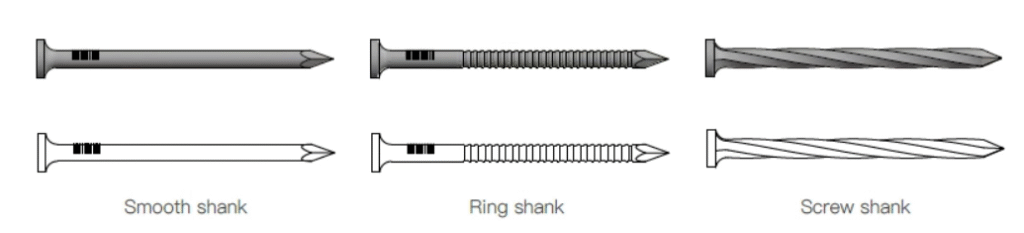
How Ring Shank and Screw Shank Coil Nails Actually Differ
A ring shank nail gets its name from the concentric rings pressed into the shank during manufacturing. These rings act like barbs. When driven into wood, the wood fibers close back around each ring, creating mechanical resistance against pull-out. The nail grips along its full embedded length.
A screw shank nail uses a continuous helical thread that spirals from just below the head to the tip. As the nailer drives it, the thread rotates the fastener slightly — not enough to slow down production, but enough to cut a threaded path into the wood fibers. The result is a fastener that behaves more like a small screw than a smooth nail.
The practical difference: ring shank nails resist static pull-out well. Screw shank nails resist both static pull-out and vibrational loosening better, which matters when pallets get stacked, strapped, and moved repeatedly over rough terrain.
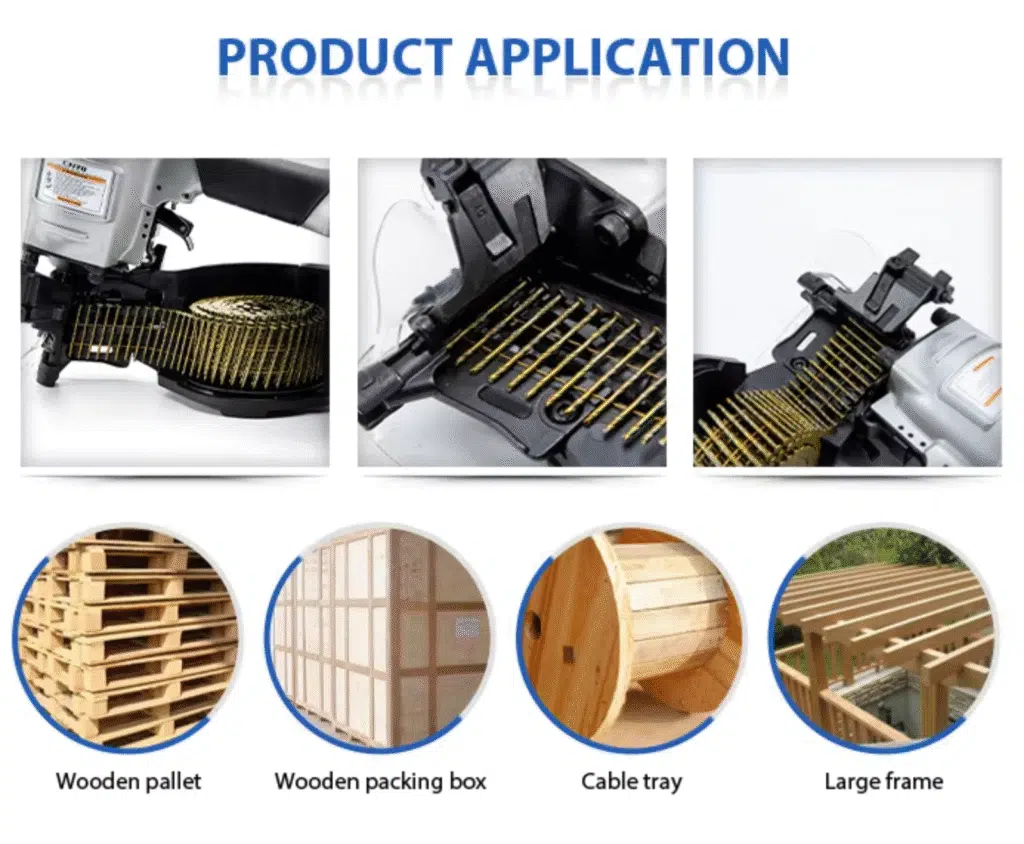
Both types are available as coil nails — collated into circular coils of 200 to 400 nails, held together by wire weld, plastic strips, or paper tape. This collation format feeds high-speed pneumatic nailers used on pallet assembly lines.
Holding Power: What the Withdrawal Numbers Mean for Pallet Assembly
In pallet construction, the nail’s primary job is resisting withdrawal — the force that pulls the nail straight back out of the wood. Ring shank nails typically offer 40 to 60 percent more withdrawal resistance than smooth shank nails of the same diameter and length. Screw shank nails can push that number higher, sometimes approaching 75 to 100 percent more withdrawal resistance compared to smooth shank, depending on wood density.
For standard GMA pallets built from mixed southern yellow pine or SPF (spruce-pine-fir), ring shank coil nails are the long-standing default. The wood is soft enough to grip the rings fully, and the withdrawal resistance comfortably exceeds what a typical 2,500- to 3,000-pound pallet load requires.
Screw shank nails earn their cost premium in three scenarios:
- Hardwood pallets. Oak, maple, and hickory pallets are common for heavy industrial loads. These dense woods resist ring penetration — a ring shank may not fully seat, reducing actual holding power below the spec-sheet number. Screw shank threads cut through dense grain more reliably.
- Thin wood or engineered deck boards. When deck boards are under 5/8 inch thick, a screw shank’s thread engagement per inch of embedment matters more. Ring shank nails need a certain minimum embedment depth for the rings to do their job. Screw shank can perform with less.
- Export and heat-treated pallets. Pallets that ship internationally go through heat treatment (ISPM 15), which can slightly alter wood fiber structure. Combined with the vibration of container shipping and multiple forklift moves, screw shank nails reduce the chance of loose joints at the destination.
If none of those describe your operation, ring shank is probably the smarter buy.
Nailer Compatibility: Which Shank Type Fits Your Existing Setup
The good news: shank type alone rarely forces a nailer change. The collation format, nail diameter, and collation angle determine compatibility — not whether the shank has rings or threads.
Most pallet lines run 15-degree coil nailers. These tools accept wire-weld or plastic-collated coil nails from roughly 1-1/2 inch to 3-1/2 inch lengths. A 15-degree wire-weld coil of .120-inch ring shank nails loads into the same magazine as a 15-degree wire-weld coil of .120-inch screw shank nails.
What does break compatibility:
- Collation angle mismatch. Swapping a 15-degree coil for a 20- to 22-degree plastic-collated coil will jam or misfeed. Confirm your nailer’s angle before ordering.
- Diameter out of range. Most 15-degree pallet nailers accept .099-inch to .131-inch diameter. Going outside that range risks driver-blade damage and poor feeding.
- Collation type mismatch. Some older nailers only accept wire-weld coils. Plastic-collated coils need a nailer designed to shear the plastic strip cleanly. Check your tool’s manual.
If you are thinking about switching from ring shank to screw shank, match the diameter, length, collation angle, and collation type to your current spec, and you should not need new tooling.
Side-by-Side Comparison Table
| Factor | Ring Shank Coil Nails | Screw Shank Coil Nails |
|---|---|---|
| Holding mechanism | Concentric annular rings grip wood fibers | Continuous helical thread cuts and locks into grain |
| Withdrawal resistance vs. smooth shank | 40–60% higher | 75–100%+ higher (wood-dependent) |
| Best wood types | Softwoods (SPF, southern yellow pine), mixed light hardwoods | Dense hardwoods (oak, maple, hickory), thin deck boards, heat-treated lumber |
| Vibration resistance | Good — sufficient for standard domestic pallet cycles | Better — preferred for export pallets and rough freight handling |
| Risk of wood splitting | Low to moderate; rings compress fibers | Slightly higher in thin or brittle stock due to thread action |
| Per-unit cost | Lower — standard commodity pricing | Moderate — additional manufacturing steps add cost |
| Nailer compatibility | Compatible with standard 15° coil nailers (same diameter/collation) | Compatible with standard 15° coil nailers (same diameter/collation) |
| Collation options | Wire weld, plastic, paper tape | Wire weld, plastic (paper less common) |
| Common pallet spec | .113″–.120″ x 2-1/4″–2-1/2″, bright or EG finish | .113″–.131″ x 2-1/4″–3″, bright or EG finish |
| Typical buyer | Standard pallet plants, crating shops, furniture frame lines | Export pallet builders, hardwood pallet specialists, heavy industrial craters |

Material, Finish, and Collation: The Specs That Affect Your Order
Choosing between ring shank and screw shank is step one. Step two is getting the rest of the spec right so your order matches what your line actually needs.
Material and finish. Most pallet nails are carbon steel wire. Bright (uncoated) finish is the cheapest and works for indoor pallets or single-use export pallets. Electro-galvanized (EG) adds a thin zinc layer for mild corrosion resistance — useful for pallets stored outdoors under cover. Hot-dip galvanized (HDG) provides thicker zinc protection for pressure-treated lumber or long-term outdoor exposure. Stainless steel nails exist but are rare in pallet production due to cost.
Collation type. Wire-weld coils use thin steel wires welded across the nail shanks to form the coil. They are the most common in pallet plants because they hold up well in humid conditions and feed reliably. Plastic-collated coils use molded plastic strips and produce less debris during firing — preferred in food-grade or clean pallet operations. Paper-tape collation is less common for pallet nails and more typical of finish nailers.
Head type. Most pallet nails use a full round head or a clipped head design. Full round heads meet building-code requirements for structural connections. Clipped heads allow tighter coil packing but may not pass inspection in certain pallet grades. Know your end-use requirements.
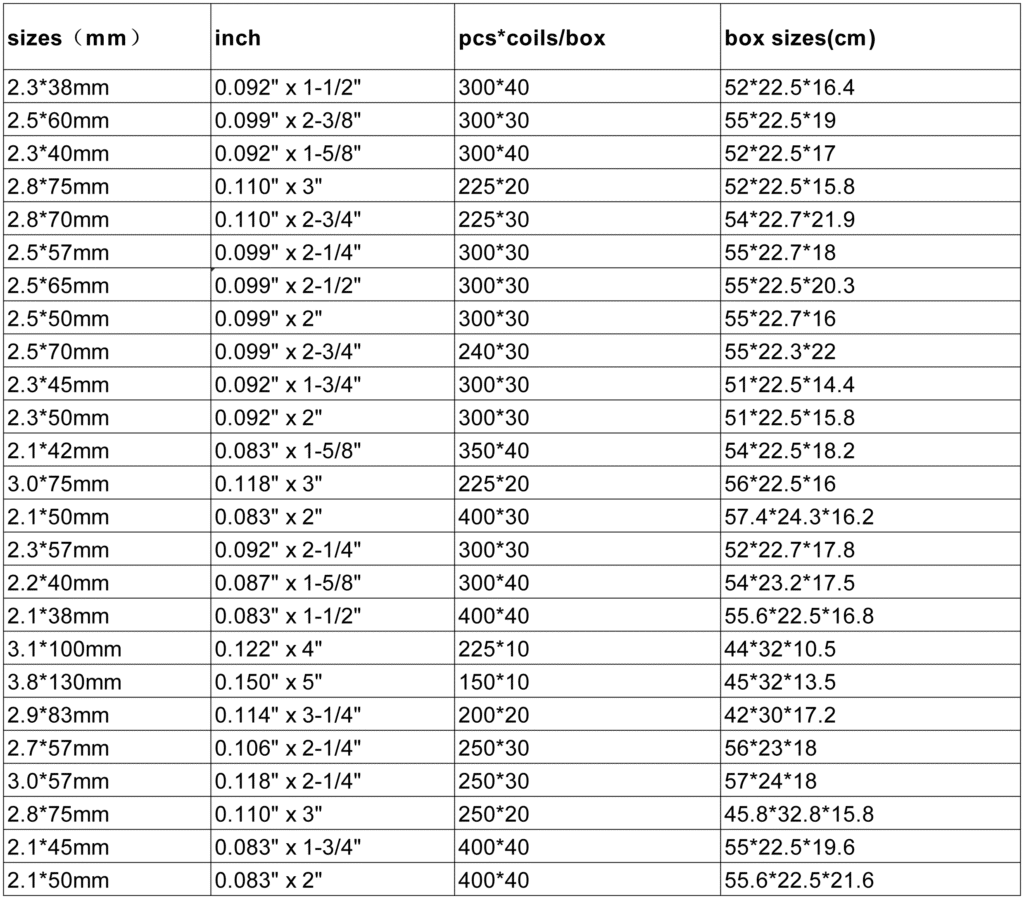
Packaging and shipping. Coil nails for pallet production ship in corrugated boxes, typically 50 to 60 pounds per box, palletized for container loading. If you are importing, specify moisture-resistant packaging — a container crossing the ocean in summer can sweat enough to rust bright-finish nails before they reach your dock.
Common Buying Mistakes Pallet Shops Make with Coil Nails
Buying on price alone and ignoring shank specs. The cheapest coil nail on a container quote might be a smooth shank or a light ring shank that does not deliver the withdrawal resistance your pallets need. A pallet that fails in the field costs more than the few dollars you saved on the nail order.
Assuming all “ring shank” nails perform the same. Ring count, ring depth, and ring profile vary between manufacturers. A shallow ring shank from a commodity mill may perform closer to a smooth shank than to a properly formed ring shank. Ask for a spec sheet that includes ring profile detail, not just “ring shank” on the label.
Switching shank types without running a test batch. Even if your nailer technically accepts both, switching from ring shank to screw shank can change nail penetration depth, driving behavior, and split rate in your specific wood mix. Run 500 to 1,000 nails through your line before committing to a container order.
Ignoring nailer maintenance when switching collation types. A nailer set up for wire-weld coils may need feed-mechanism adjustment for plastic-collated coils. Debris buildup from plastic collation fragments can cause misfires over time if the tool is not cleaned regularly.
Not confirming nailer angle. The difference between a 15-degree and a 20- to 22-degree coil nailer is not always obvious by looking at the tool. Check the model number against the manufacturer spec sheet. A mismatched coil jams on the first rack.
Overlooking packaging for imported coils. Rusted nails on arrival are a real problem. If you are sourcing from overseas, ask the supplier how they package for sea freight. Look for vacuum-sealed inner bags, desiccant packs, and pallet wrapping that keeps moisture out. Bright-finish nails need more protection than galvanized.
FAQ
Which shank type holds better in hardwood pallet lumber?
Screw shank nails generally hold better in dense hardwoods because the helical thread cuts its own path and resists loosening from vibration. Ring shank nails can struggle in very hard species if the rings do not fully seat. For mixed-species pallet stock, ring shank is usually sufficient and more cost-effective.
Can I run screw shank nails through a standard coil nailer?
Most 15-degree wire-weld and plastic-collated coil nailers accept both ring shank and screw shank nails, as long as the diameter and collation match the nailer’s specs. Always check your nailer manufacturer’s fastener compatibility chart before switching shank types.
Are screw shank coil nails more expensive than ring shank?
Yes. Screw shank nails typically cost more because the helical thread requires more manufacturing steps. For high-volume pallet operations, the per-unit price difference adds up fast. Many buyers reserve screw shank for premium or export pallets and use ring shank for standard production.
Do I need a different driver angle for each shank type?
No. Shank type does not change the collation angle. A 15-degree wire-weld coil of ring shank nails loads the same as a 15-degree wire-weld coil of screw shank nails. The variables that affect fitment are collation angle (15-degree or 20- to 22-degree), collation type (wire weld, plastic, or paper), and nail diameter.
What is the most common pallet nail spec in North America?
A .113-inch to .120-inch diameter, 2-1/4-inch to 2-1/2-inch length, ring shank, wire-weld or plastic-collated, 15-degree coil nail. This spec balances holding power, nailer speed, and material cost for standard GMA pallet production. Screw shank versions of the same diameter and length are common for export-grade or heavy-duty pallets.
Internal Link Suggestions
- Browse the full coil nail product range with specs and nailer fitment notes
- Review coil nail collation types, diameters, and nailer fitment details
- Explore our complete industrial fastener range for pallet production
Next Step
If you are comparing ring shank and screw shank coil nails for your pallet line and want to see actual specs, samples, or a landed-cost quote, reach out to the FastenerNails team. We can help match the right diameter, finish, and collation to your nailer model and production volume — no guesswork, no generic recommendations.
 English
  Arabic
  Spanish
  Portuguese