
Introduction: The Hidden Science of Pallet Fasteners
In the high-stakes world of global logistics, a single pallet failure can lead to thousands of dollars in damaged cargo and insurance claims. While most managers focus on wood quality, the real hero (or villain) is the coil nail.
At Jinan Elite Technology Co., Ltd., we’ve analyzed millions of fastening cycles. We know that choosing between ring shank, screw shank, and smooth shank coil nails isn’t just a preference—it’s a calculated engineering decision based on wood density, moisture content, and load requirements.
1. Material Matters: Q195 vs. Q235 Carbon Steel
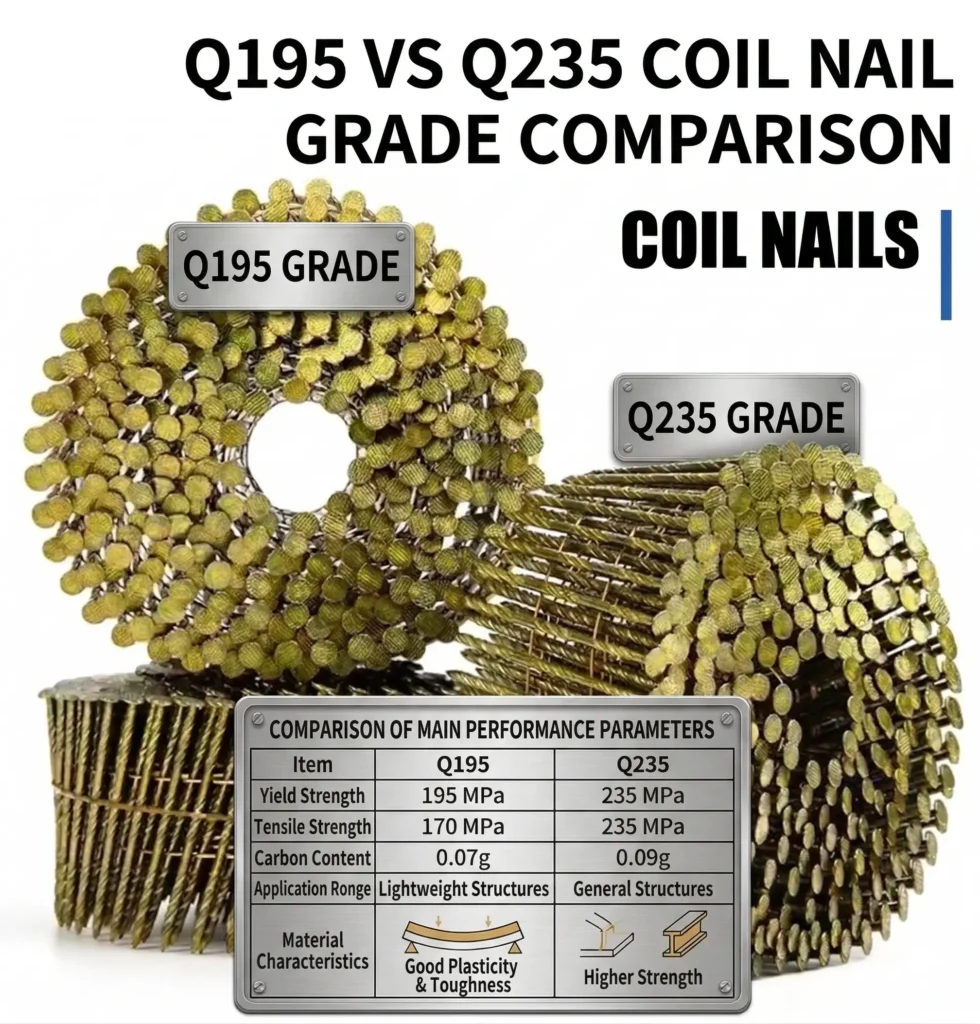
Not all steel wire is created equal. Most “cheap” nails use low-grade recycled wire that bends too easily under pressure.
- Q195 Steel: Offers high flexibility. It’s excellent for standard pallet assembly where the wood isn’t excessively hard.
- Q235 Steel: Contains higher carbon content. We recommend this for heavy-duty industrial fasteners because it provides the stiffness needed to penetrate hardwood without “fish-hooking” or bending.
Pro Tip: Ask your supplier for a material mill certificate. If they can’t provide it, you’re likely buying inferior wire that will lead to nail gun jamming and increased downtime.
2. Deep Dive: Shank Styles and Withdrawal Resistance
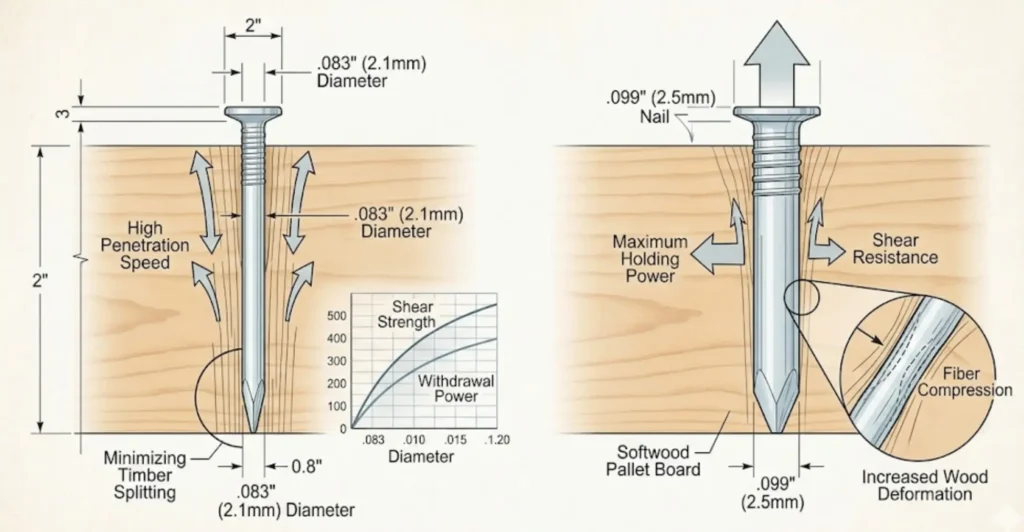
The “holding power” of a nail is scientifically measured as withdrawal resistance.
- Ring Shank Coil Nails (The Gripper): These are engineered with deep annular threads. When driven into softwood, the wood fibers collapse into the rings and then expand back out, creating a mechanical lock. This is the gold standard for softwood pallets used in high-vibration environments (rail or sea freight).
- Screw Shank Coil Nails (The Driver): Also known as helical threads, these rotate as they enter the timber. This rotation reduces friction and prevents the wood from splitting, which is critical when working with dried hardwood pallets.
- Smooth Shank: While cheaper, these rely purely on friction. We only recommend these for temporary crates or single-use pallets where cost is the only driver.
3. Technical Specification Table (Quick Reference)
| Specification | Standard Range | Recommended Application |
|---|---|---|
| Diameter | 2.1mm – 3.8mm | 2.1mm is standard; 2.8mm+ for heavy skids |
| Length | 25mm – 130mm | 50mm-64mm is the “sweet spot” for pallets |
| Collation Angle | 15 Degree | Compatible with most pneumatic coil nailers |
| Point Style | Diamond / Blunt | Diamond for speed; Blunt to prevent splitting |
| Coating | Bright / EG / HDG | HDG for 60+ days of sea transit |
4. Why Consistency in Wire Collation is Your Secret Profit Margin

If your production line stops for 5 minutes every hour due to a jammed gun, you lose 8% of your daily output. Most jams aren’t caused by the tool, but by wire collation issues:
- Brittle Welding: If the copper-coated wire is too brittle, it snaps before entering the wood.
- Inconsistent Spacing: If the distance between nails varies by even 0.5mm, the feeding pawl of your MAX or Bostitch gun will miss a beat. At Jinan Elite, our automated welding machines maintain a tolerance of ±0.2mm, ensuring your high-speed automated pallet production stays “high-speed.”
5. Rust Protection: Understanding the Zinc Layer
For international shipping, “rust-free” is a contract requirement.
- Electro-Galvanized (EG): Provides 8-12 microns of zinc. Good for 2 weeks of humidity.
- Hot Dipped Galvanized (HDG): Provides 40+ microns. This is essential for pallets stored outdoors or shipped via ocean freight.
- Stainless Steel (304/316): Rare in pallets, but required for food-grade or chemical-resistant packaging.
FAQ: Expert Troubleshooting for Pallet Manufacturers
Q1: Why do my boards keep splitting when I use 2.5mm nails?
A: You likely have high-density hardwood. Switch to a blunt point instead of a diamond point. A blunt point “punches” through the fibers instead of wedging them apart, significantly reducing splits.
Q2: Can I use 15-degree nails in a 16-degree nail gun?
A: We strongly advise against it. Even a 1-degree difference puts excessive lateral pressure on the firing pin, leading to premature tool wear and frequent misfires.
Q3: How do I calculate the number of coils I need for 1,000 pallets?
A: On average, a standard 48×40 pallet uses 78-90 nails. At 250 nails per coil, you’ll need approximately 315 to 360 coils per 1,000 pallets.
Partner with a Specialist, Not Just a Supplier
Stop fighting with low-quality fasteners. Jinan Elite provides the precision and reliability required for modern wooden pallet assembly.
- 🚀 Request a Factory Tour: See our quality control in action.
- 📦 Sample Pack: Get a 5-coil test kit shipped to your facility.
- 💰 Direct Pricing: Skip the middleman and save on container loads.
 English
  Arabic
  Spanish
  Portuguese