
A jumbo coil nail reel can look acceptable from the outside while a crushed paper edge, shifted winding or damaged collation is waiting to interrupt the first automatic-line trial. Receiving inspection should therefore decide which reels may move to controlled testing, which need supplier review, and which must remain quarantined. It should not try to prove line compatibility from appearance alone.
The current jumbo coil nails for automatic pallet production are documented as 15-degree wire-collated nails supplied on a large paper reel, with smooth, ring and screw shanks available and up to 3,000 nails per reel. “Up to” is a product-family ceiling, not evidence that every received reel contains that count. The purchase order, carton label and approved sample still control the exact lot.
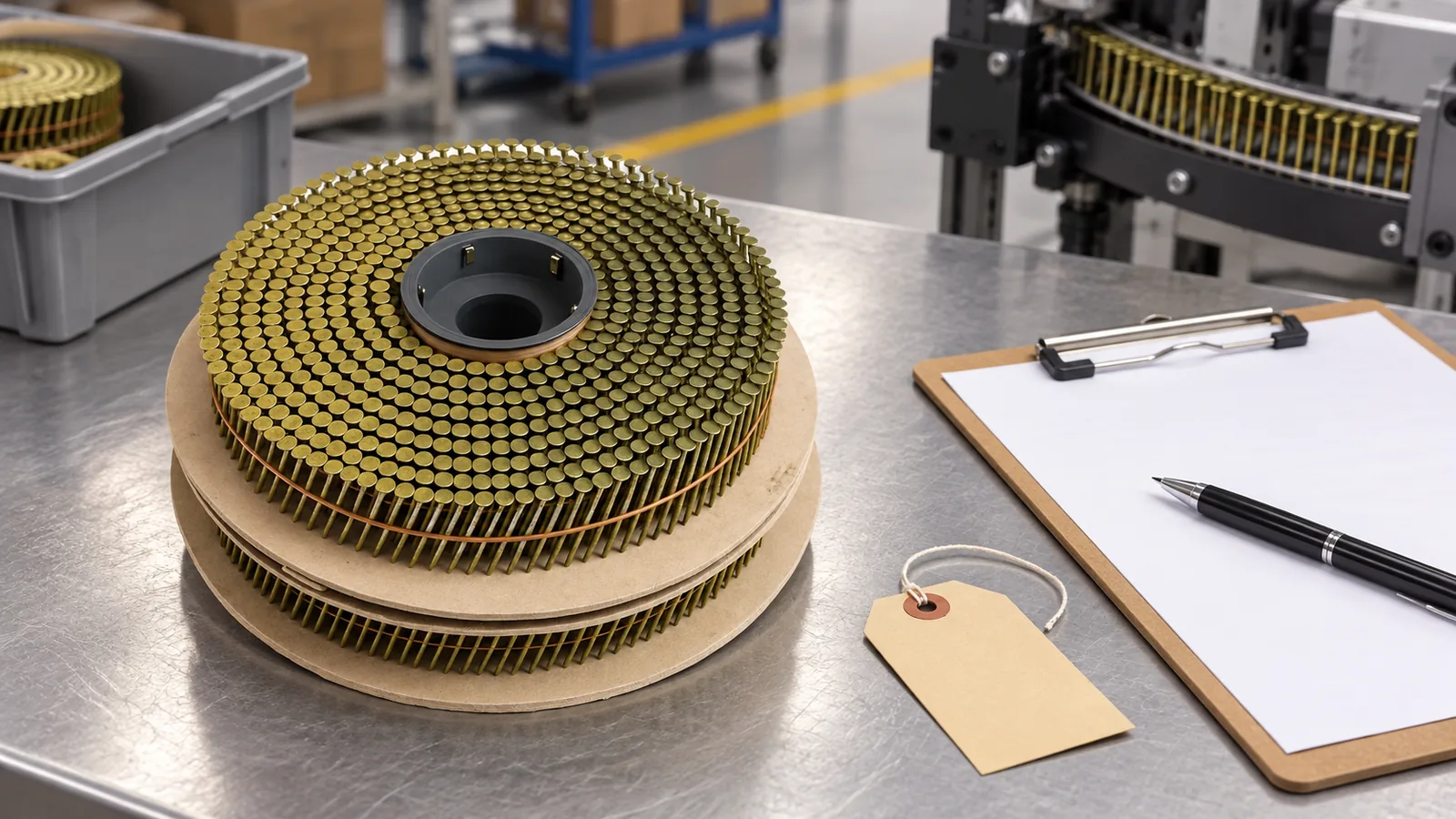
Create a Hold Area Before Opening Cartons
Put the shipment in a dry, clearly identified receiving zone before removing protective packaging. Record the supplier lot, purchase-order line, nail specification, shank type, reel identity, carton count and visible handling condition. Photograph each side of any carton with crushing, puncture, water staining or broken tape before it is moved.
Keep accepted-looking cartons separate from damaged cartons during unloading. A simple physical separation prevents an operator from selecting an unchecked reel when the trial starts. If labels from two nail specifications appear in one pallet position, hold the entire affected group until the identity is reconciled.
The earlier jumbo-versus-standard coil nail line comparison explains why reel format and feed system must be treated as a matched production decision. Receiving staff can confirm the delivered format; the line owner must still confirm that the feeder, guide path, drive tool and programmed cycle are the approved setup.
Inspect the Paper Reel Without Disturbing the Winding
Open a representative carton on a clean bench and support the reel across its full base. Avoid lifting it by the paper edge or pulling an exposed nail strip to “see whether it feeds.” Check the following points and keep close photographs with the lot record:
| Inspection point | Acceptable evidence | Hold condition |
|---|---|---|
| Paper reel edges | Circular, supported and free from obvious crushing | Buckling, tears, wet areas or delamination |
| Winding | Layers remain seated without visible telescoping | Shifted layers, loose loops or a displaced outer wrap |
| Collation | Wire and nail sequence appear continuous in the visible area | Broken wire, detached nails or obvious spacing disruption |
| Nail identity | Head, shank and point match the approved sample and order | Mixed shank style, uncertain dimension or foreign fastener |
| Label traceability | Lot and order line remain readable and linked to the carton | Missing, conflicting or detached identity label |
This is a visual receiving screen, not a dimensional acceptance plan. Measure the nail diameter, length, head and other agreed features with the inspection method and sampling level in the purchase specification. Avoid forcing a gauge into the wound reel where it can deform the collation.

Define Damage Classes Before the Team Finds a Defect
Agree three dispositions in advance. Minor packaging damage may be documented while the protected reel remains intact. Suspected reel or collation damage requires quarantine and a supplier decision. Mixed identity, wet paper, severe crushing or loose nail layers should stop release until the responsible quality owner signs a disposition.
A “use first and see” decision hides the original condition. Once a questionable reel enters the feeder, it becomes difficult to distinguish shipping damage from handling or setup damage. Keep at least one untouched reel from the same affected group as comparison evidence until the claim or corrective action is closed.
Release a Named Reel to a Controlled Line Trial
Receiving acceptance does not authorize bulk line use. Select a named reel and connect its carton, lot, inspection photos and measurements to the trial record. Confirm the approved nail specification, feeder and tooling before loading. The public product evidence does not support hand-tool compatibility for this reel format, so avoid an improvised trial in a standard coil nailer.

Run the supplier- and machine-approved trial sequence. Record feed interruptions, collation behavior, drive result and any reel-edge movement against cycle count or trial stage. If the reel is stopped and restarted, note that event rather than merging both periods into one result. A pass should identify the exact reel and setup; it should not become a blanket claim for every future lot.
The coil nail changeover control for preventing mixed sizes is useful when the approved reel moves from quarantine to production. Clear the previous specification, verify the new line identity, and retain the release record at the loading point.
Send the Supplier Evidence That Supports a Decision
When a reel is held, send an evidence set rather than a general complaint. Include the order line, lot, carton identity, receiving time, handling condition, overall reel photographs, detailed damage photographs, dimensional results and the requested decision. State whether the reel remained unopened, was inspected on a bench or entered a controlled trial.
For a new order, ask the supplier to confirm the exact nail dimensions and shank, collation angle, reel format, nominal reel quantity, packaging protection and automatic-line compatibility evidence. Final compatibility remains subject to the buyer's actual feeder and trial.
Related Jumbo Coil Nail Controls
- Compare feed-system evidence before choosing wire-collated coil nails
- Measure reload downtime without confusing it with nail quality
- Build a drive-depth trial around the nailer and wood variables
Request a Lot-Specific Review
Send the nail dimensions, shank type, feeder or automatic-line model, target reel quantity, trial method, packing requirement and receiving concerns through the FastenerNails inquiry form. Ask for written confirmation against the exact order and sample rather than relying on a generic jumbo-reel description.
 English
  Arabic
  Spanish
  Portuguese