
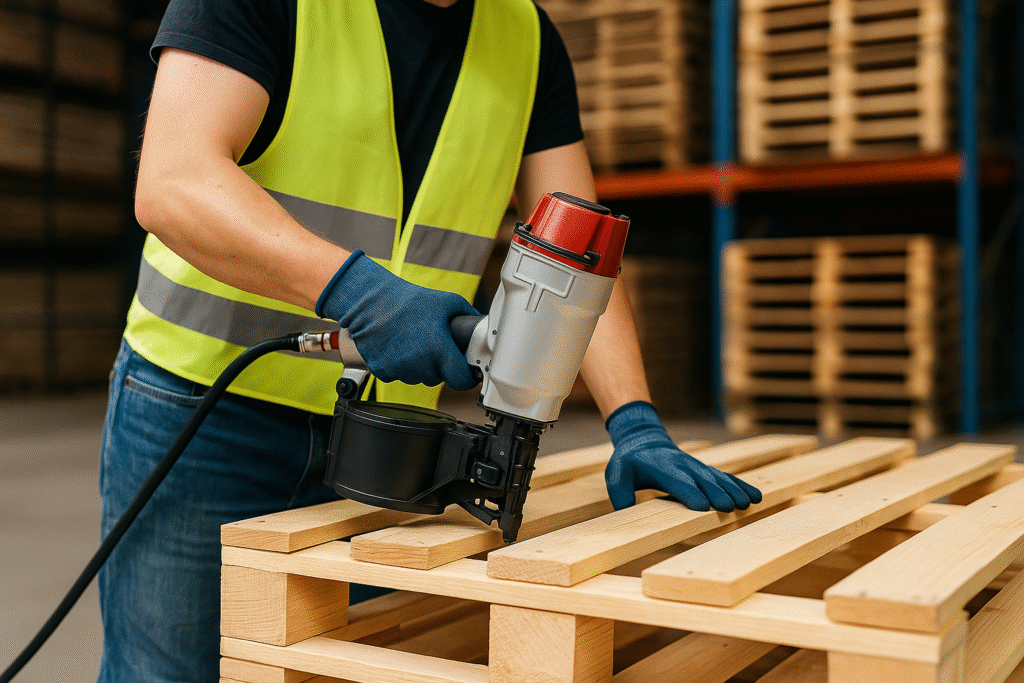
If you’ve ever seen a high-speed pallet production line or a framing crew in action, you’ve heard the rhythmic thwack-thwack-thwack of a pneumatic nailer. Most likely, they’re using coil nails.
But as anyone in the fastener trade knows, not all coils are created equal. Whether you’re a buyer for a construction firm or a distributor looking to stock the right specs, there’s a lot more to it than just “nails on a wire.”
I’ve spent a lot of time looking at spec sheets and hearing from guys in the field. Here’s the “no-fluff” breakdown of what you need to know.
1, Let’s Talk Capacity: How many nails are actually in that box?
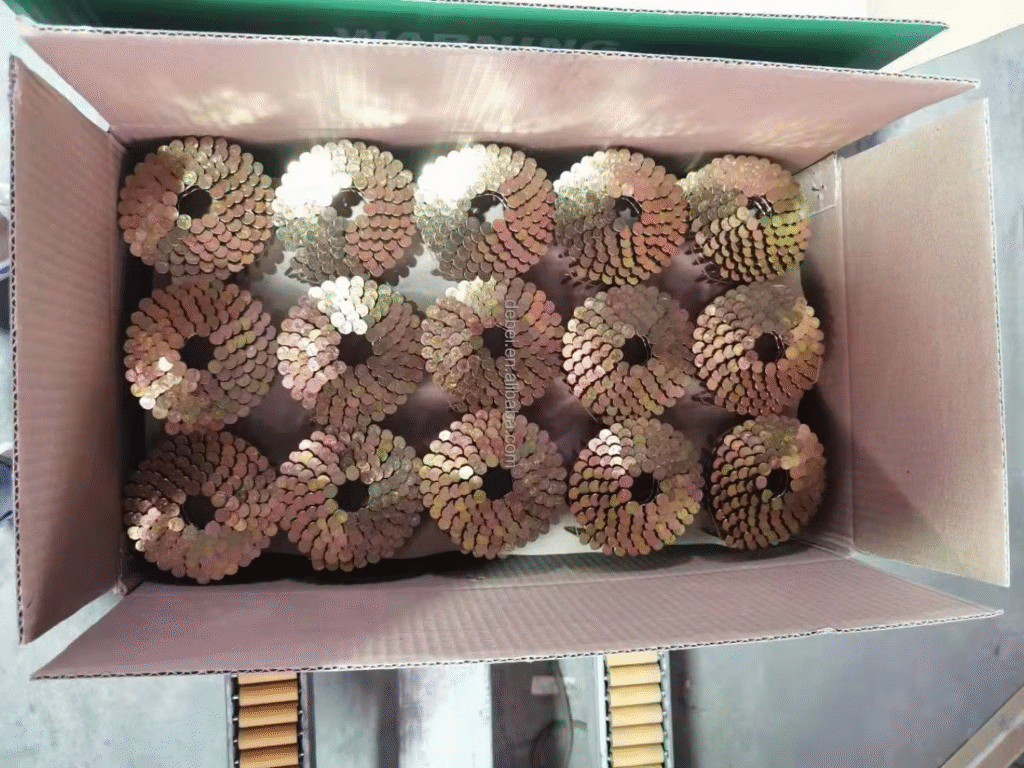
The most common question I get is: “How many nails am I actually paying for?” It’s a fair question because it directly affects your downtime. If you’re using stick nails, you’re reloading every 30 seconds. With coils, you’re looking at 200 to 400 nails per load.
Based on our recent production runs, here is how the math usually works out for shipping and inventory:
| sizes(mm) | inch | pcs*coils/box | box sizes(cm) |
| 2.3*38mm | 0.092″ x 1-1/2″ | 300*40 | 52*22.5*16.4 |
| 2.5*60mm | 0.099″ x 2-3/8″ | 300*30 | 55*22.5*19 |
| 2.3*40mm | 0.092″ x 1-5/8″ | 300*40 | 52*22.5*17 |
| 2.8*75mm | 0.110″ x 3″ | 225*20 | 52*22.5*15.8 |
| 2.8*70mm | 0.110″ x 2-3/4″ | 225*30 | 54*22.7*21.9 |
| 2.5*57mm | 0.099″ x 2-1/4″ | 300*30 | 55*22.7*18 |
| 2.5*65mm | 0.099″ x 2-1/2″ | 300*30 | 55*22.5*20.3 |
| 2.5*50mm | 0.099″ x 2″ | 300*30 | 55*22.7*16 |
| 2.5*70mm | 0.099″ x 2-3/4″ | 240*30 | 55*22.3*22 |
| 2.3*45mm | 0.092″ x 1-3/4″ | 300*30 | 51*22.5*14.4 |
| 2.3*50mm | 0.092″ x 2″ | 300*30 | 51*22.5*15.8 |
| 2.1*42mm | 0.083″ x 1-5/8″ | 350*40 | 54*22.5*18.2 |
| 3.0*75mm | 0.118″ x 3″ | 225*20 | 56*22.5*16 |
| 2.1*50mm | 0.083″ x 2″ | 400*30 | 57.4*24.3*16.2 |
| 2.3*57mm | 0.092″ x 2-1/4″ | 300*30 | 52*22.7*17.8 |
| 2.2*40mm | 0.087″ x 1-5/8″ | 300*40 | 54*23.2*17.5 |
| 2.1*38mm | 0.083″ x 1-1/2″ | 400*40 | 55.6*22.5*16.8 |
| 3.1*100mm | 0.122″ x 4″ | 225*10 | 44*32*10.5 |
| 3.8*130mm | 0.150″ x 5″ | 150*10 | 45*32*13.5 |
| 2.9*83mm | 0.114″ x 3-1/4″ | 200*20 | 42*30*17.2 |
| 2.7*57mm | 0.106″ x 2-1/4″ | 250*30 | 56*23*18 |
| 3.0*57mm | 0.118″ x 2-1/4″ | 250*30 | 57*24*18 |
| 2.8*75mm | 0.110″ x 3″ | 250*20 | 45.8*32.8*15.8 |
| 2.1*45mm | 0.083″ x 1-3/4″ | 400*40 | 55*22.5*19.6 |
| 2.1*50mm | 0.083″ x 2″ | 400*40 | 55.6*22.5*21.6 |
Pro Tip: Look at the box sizes in the spec sheet. If you’re calculating container space (CBM), notice that as the nails get longer and thicker (like the 3.8*130mm), the quantity per box drops significantly to keep the weight manageable for the workers on-site.
2, Is there a “Standard” for Coil Nails?
Yes and no. While there are international standards (like ASTM), the “standard” most people care about is compatibility.
The industry standard for wire-collated nails is 15 degrees. This is the angle that fits 90% of the pneumatic guns on the market (Bostitch, Max, Makita, etc.).
If you see someone asking for “15-degree coil nails,” they aren’t looking for something niche—they’re looking for the universal fit. However, always check the Shank Type:
- Smooth: For general construction where holding power isn’t the primary concern.
- Ring: The rings act like barbs. Once these go into a pallet, they aren’t coming out without a fight.
- Screw: Best for hardwoods and flooring.
3, What defines “A Grade” quality? (The “Human” Factor)
In the factory, we talk about “A Grade,” but on the job site, they just call it “nails that don’t jam my gun.”
A true Grade A coil nail has three hallmarks:
- The Weld: The wire holding the nails together needs to be strong enough to stay in a coil, but brittle enough to snap cleanly when the driver hits it. If the wire is too “gummy,” it wraps around the nose of the gun. That’s a 10-minute delay you don’t want.
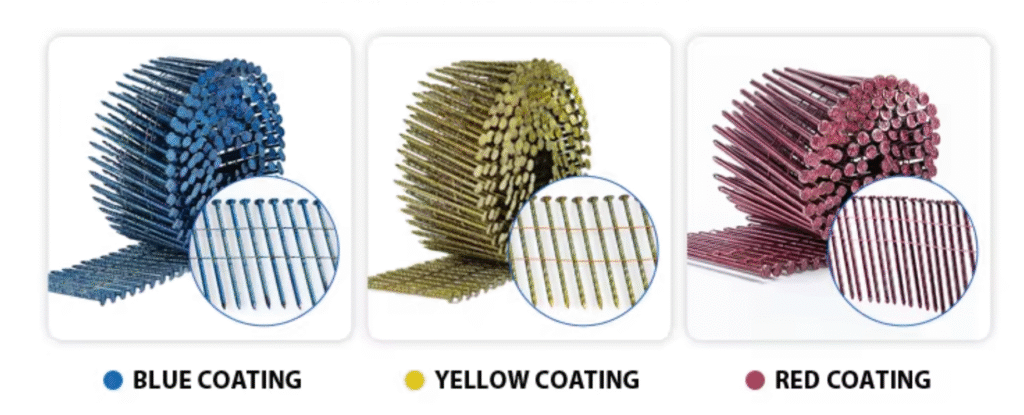
- The Coating: Whether it’s Bright, EG, or HDG, it needs to be uniform. Rusty nails in the box are a sign of poor storage or cheap raw materials.
- The Points: They need to be sharp enough to prevent wood splitting, especially when working with seasoned timber.
4, What are they actually used for?
If you’re buying coil nails, you’re likely in one of these three industries:
- Pallet & Crate Building: By far the biggest user. The high volume makes the coil format a necessity.
- Siding and Fencing: Where you have long runs of material and don’t want to carry 50 boxes of stick nails.
- Roofing: Specific short, large-head coil nails are the go-to for asphalt shingles.
Choosing the right nail isn’t just about the cheapest price per thousand. It’s about the total cost of the job. If a box of nails is $2 cheaper but jams the gun three times an hour, you’re losing money on labor.
Are you looking to optimize your next container load or unsure which shank type fits your specific timber? Shoot us a message with your current specs—we’ve probably seen (and solved) your specific challenge before.





 English
  Arabic
  Spanish
  Portuguese