
Coil nail shank types should be selected before price comparison. The shank controls how the nail drives into the wood, how much grip it creates after driving and how suitable the order is for a specific pallet, crate, siding or packaging line. If the shank is treated as a small detail, buyers can receive nails that look correct in the carton but do not match the wood or nailer in production.
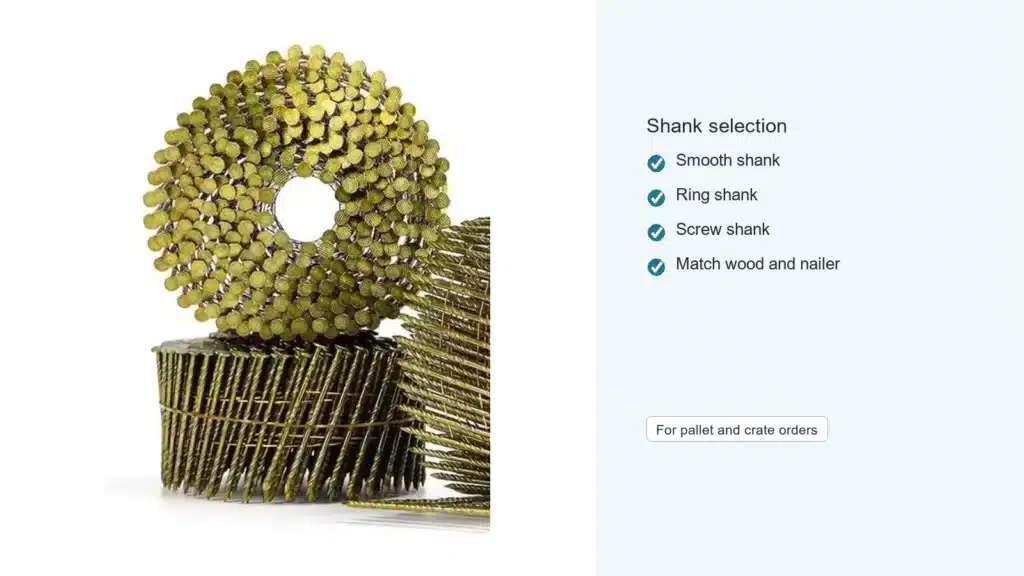
FastenerNails lists clavos en espiral with smooth, ring and screw shank options. The same page also shows that coil nail orders can vary by nail diameter, length, quantity per coil, finish and packing quantity. This article focuses only on shank selection, because it is one of the most common specification points buyers need to confirm before mass orders.
What the Shank Does in a Coil Nail
The shank is the long body of the nail between the head and the point. In a wire-collated coil nail, the shank must do two jobs at the same time. First, it must pass through the coil nailer smoothly. Second, after the nail is driven, it must hold the wood parts together with the right level of grip for the application.
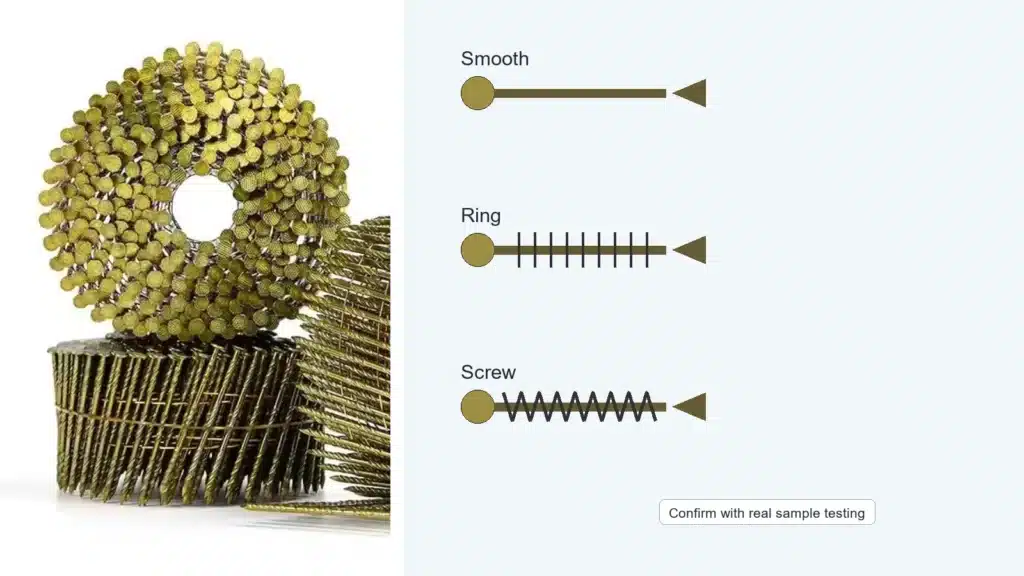
Smooth, ring and screw shanks solve this problem in different ways:
| Tipo de mango | Main Character | Typical Buying Reason |
|---|---|---|
| Caña lisa | Plain shank body | Fast driving and cost control in suitable softwood or lighter-duty work |
| Vástago del anillo | Circular ridges along the shank | Better grip where withdrawal resistance matters |
| Vástago del tornillo | Spiral thread-like shank | Stronger mechanical bite in dense wood or demanding fastening |
These are not quality grades. A smooth shank nail can be the right product when the application is suitable. A screw shank nail can be the wrong product if it is over-specified, difficult to drive or mismatched with the nailer and wood. The goal is to match the shank to the real job.
Smooth Shank Coil Nails
Smooth shank coil nails have a plain body. They are generally easier to drive because there are no ridges or spiral ribs resisting entry into the wood. For high-speed production, this can be useful when the wood is compatible and the joint does not need aggressive withdrawal resistance.
Buyers often consider smooth shank coil nails when:
- The wood is relatively soft
- The pallet or crate is used for lighter or shorter-term duty
- Production speed and driving consistency are priorities
- The buyer wants a cost-conscious specification
- Samples have already shown acceptable holding performance
Smooth shank does not mean weak by default. It means the grip mainly comes from the nail body, head and wood compression around the driven nail. For some packaging, furniture, light framing or temporary structures, that may be enough. For heavy pallets, repeated handling, vibration or dense hardwood, smooth shank may not provide the margin buyers want.
Ring Shank Coil Nails
Ring shank coil nails have ridges around the shank. These ridges increase friction and make withdrawal more difficult after the nail is driven. For pallet and crate buyers, ring shank is often the first upgrade considered when smooth shank is too easy to pull out.
Ring shank coil nails can make sense for:
- Wooden pallet assembly
- Crate and export packaging
- Boards that may experience vibration during transport
- Applications where the nail must resist backing out
- Softwood or medium-density wood where ridges can grip effectively
The important point is that ring shank selection should still be tested. If the ring profile is too aggressive for a thin board, it may increase splitting risk. If the wood is too dense, driving may require more force and the nailer setup becomes more important. If the ring profile is poorly made, it can also create inconsistent driving.
When requesting ring shank coil nails, buyers should confirm nail diameter, nail length, ring profile, point style, finish and collation details together. Isolating the shank type from the rest of the specification creates avoidable risk.
Screw Shank Coil Nails
Screw shank coil nails have a spiral form that helps the nail bite into the wood. They are often chosen when the buyer wants stronger holding performance than a basic smooth shank nail can provide. Screw shank may be useful for dense wood, flooring, roofing, heavy crates or other demanding applications.
The advantage is grip. The tradeoff is that screw shank nails can require more careful matching with wood hardness, nailer power, nail diameter and point type. A nail that holds strongly but bends, jams or splits the board is not a successful specification.
Before moving to screw shank, buyers should ask:
- Is the wood hard enough to need this shank?
- Does the nailer have enough driving power?
- Is the nail length suitable for board thickness?
- Does the point style reduce splitting risk?
- Has a sample test been run on the real wood?
FastenerNails also has existing content on wire-collated coil nail compatibility. That check should be done together with shank selection, because shank type is only one part of nailer performance.
Match Shank Type to Wood and Application
The best shank type depends on the wood and the service conditions. A pallet factory using softwood may not need the same shank as a crate builder using dense hardwood. A one-way export pallet may not need the same specification as reusable industrial packaging.
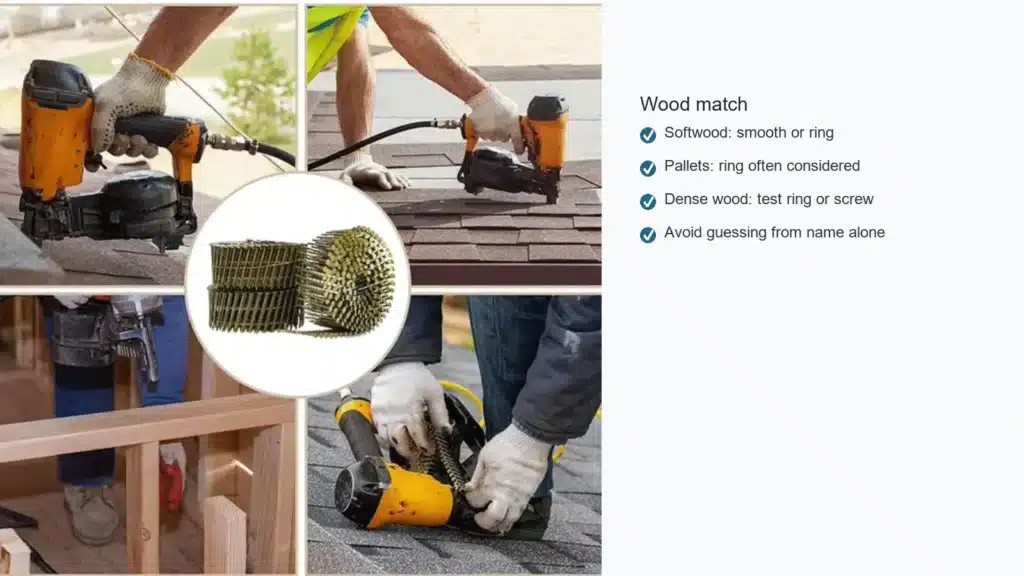
Useful selection logic:
| Situation | Common Direction | Reason |
|---|---|---|
| Softwood and light packaging | Smooth or ring shank | Easier driving, controlled cost, enough grip after sample approval |
| Standard pallet assembly | Vástago del anillo | Better resistance to withdrawal under handling and vibration |
| Dense hardwood or heavy-duty crate | Ring or screw shank | More grip may be needed, but driving must be tested |
| Thin boards or splitting-sensitive wood | Confirm point style and sample test | Shank alone cannot prevent splitting |
| Unknown wood source | Start with samples | Avoid container-level mistakes |
This logic should not be treated as a universal rule. Local lumber, moisture content, board thickness, nail angle and operator technique all affect the final result. Buyers should use it as a starting point, then test before bulk orders.
Do Not Separate Shank Type From Nail Size
Shank type must be matched with nail diameter and length. A ring shank nail that is too short may not provide enough penetration. A screw shank nail that is too thick may be difficult to drive in dense wood. A smooth shank nail that is too long for thin boards may create splitting or exit issues.
On the coil nails product page, FastenerNails presents coil nail options across different diameters and lengths. Buyers should request a complete specification, not just a shank name. A practical inquiry should include:
- Nail length
- Nail diameter
- Head type if required
- Shank type
- Point style if known
- Finish
- Collation angle and wire position
- Quantity per coil and carton packing
- Target nailer model or magazine requirements
- Wood type and board thickness
This information lets the supplier check whether the requested shank is realistic for the job. It also helps avoid a common problem: the buyer asks for the strongest-looking nail, but the production line needs the easiest-driving nail that still passes the application test.
Sample Testing Before Bulk Orders
A sample test is the simplest way to reduce risk. Buyers should test the shank type with the real wood, real nailer and real operator setup. It is not enough to inspect the coil visually. The nail must feed, drive and hold correctly.
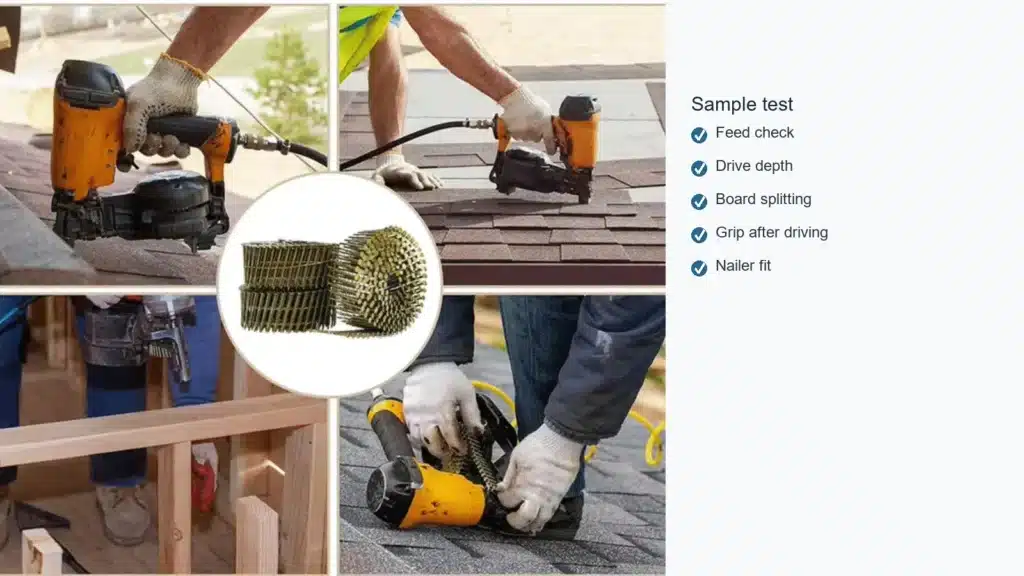
During testing, check:
- Whether the coil loads smoothly into the magazine
- Whether the nails feed without deformation
- Whether the nail head sits at the correct depth
- Whether boards split, lift or crack
- Whether the nail bends in harder sections
- Whether the joint feels suitable after fastening
- Whether the collation wire remains consistent
Do not use one perfect test piece as the only approval. Test several pieces, including harder knots or denser boards if those appear in normal production. The supplier also needs clear feedback: not just “good” or “bad”, but what happened during driving.
Finish and Shank Type Should Be Chosen Together
Shank type affects holding. Finish affects surface protection and sometimes driving behavior. Buyers should not mix the two decisions without thinking. Bright, galvanized, painted or other finishes may be used depending on indoor storage, humidity, exposure and buyer requirements.
For finish selection, the existing guide on electro-galvanized vs hot-dip galvanized coil nails explains how coating choice should be based on exposure rather than a simple price comparison. The same procurement discipline applies here. Select the shank for holding and the finish for the environment, then confirm that the full specification runs correctly in the nailer.
Common Ordering Mistakes
Several mistakes appear repeatedly in coil nail procurement.
The first mistake is asking for “standard pallet nails” without explaining the pallet design. Pallets vary by deck board thickness, stringer material, load expectations and production speed. A standard name does not replace a specification.
The second mistake is assuming screw shank is always better than ring shank. It may hold more aggressively in some applications, but it may also increase driving resistance. If ring shank passes the job requirement and runs more smoothly, it may be the better commercial choice.
The third mistake is changing shank type while keeping every other parameter unchanged. If the buyer moves from smooth to ring or screw shank, nailer performance, point behavior and splitting risk should be checked again.
The fourth mistake is judging only by loose nail photos. Coil nails must be evaluated as collated products. Wire position, coil diameter, winding and packing also affect production.
What to Send When Requesting a Quote
The fastest way to get a useful quote is to send complete application details. A good request is short but specific.
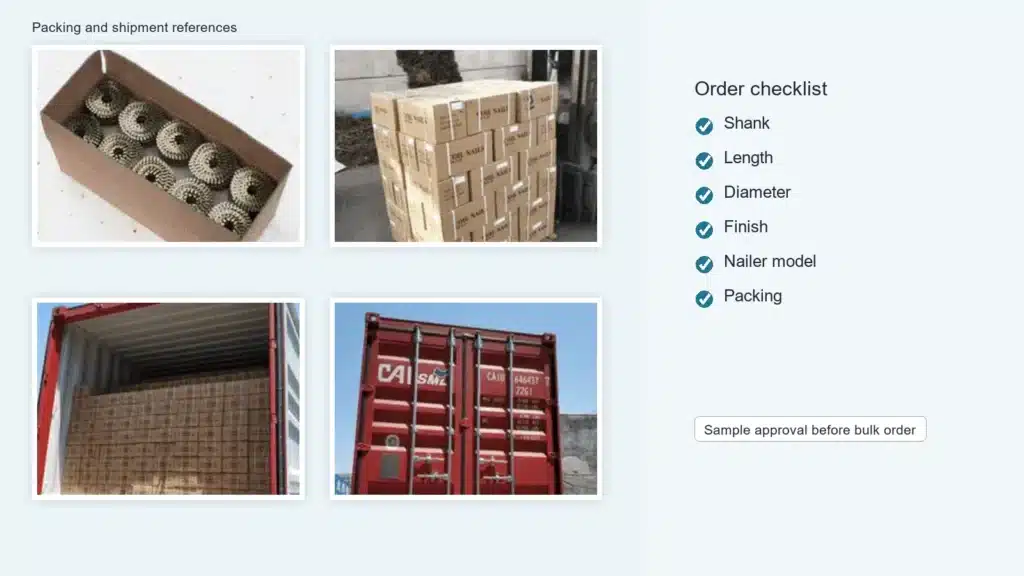
Include:
- Smooth, ring or screw shank requirement
- Nail diameter and length
- Target wood type and board thickness
- Application: pallet, crate, roofing, siding, flooring or other
- Nailer model or accepted coil dimensions
- Finish requirement
- Packing preference
- Estimated order quantity
- Whether samples are needed before mass production
If the buyer is unsure, it is better to say so. A supplier can compare reasonable options only when the use case is clear.
Conclusión
Coil nail shank types are not a cosmetic detail. Smooth shank, ring shank and screw shank coil nails each have a place in pallet and crate production. The best choice depends on wood, load, nailer setup, finish, point style and sample results.
For export orders, do not select the shank type by name alone. Build a complete specification, test samples in real production conditions and confirm packing before bulk shipment. To discuss a coil nail specification, send your target size, shank type, wood details and nailer requirements through the FastenerNails contact page.
PREGUNTAS FRECUENTES
Are ring shank coil nails always better than smooth shank coil nails?
No. Ring shank nails provide more grip in many applications, but smooth shank nails may be better for fast driving, lighter-duty work or cost-controlled jobs where testing confirms acceptable performance.
When should buyers choose screw shank coil nails?
Screw shank coil nails are often considered for dense wood or demanding fastening where stronger mechanical bite is needed. They should still be tested with the real nailer and wood before bulk orders.
Can I change from smooth shank to ring shank without changing nail size?
Sometimes, but it should not be assumed. Changing shank type can affect driving resistance, splitting behavior and nailer performance. Sample testing is recommended.
What information does a supplier need for shank selection?
A supplier should know the application, wood type, board thickness, nail length, nail diameter, shank type, finish, nailer model, collation details and packing requirement.
Is shank type more important than finish?
They solve different problems. Shank type affects holding in the wood. Finish affects surface protection and exposure suitability. Both should be chosen together.
 Spanish
  English
  Arabic
  Portuguese